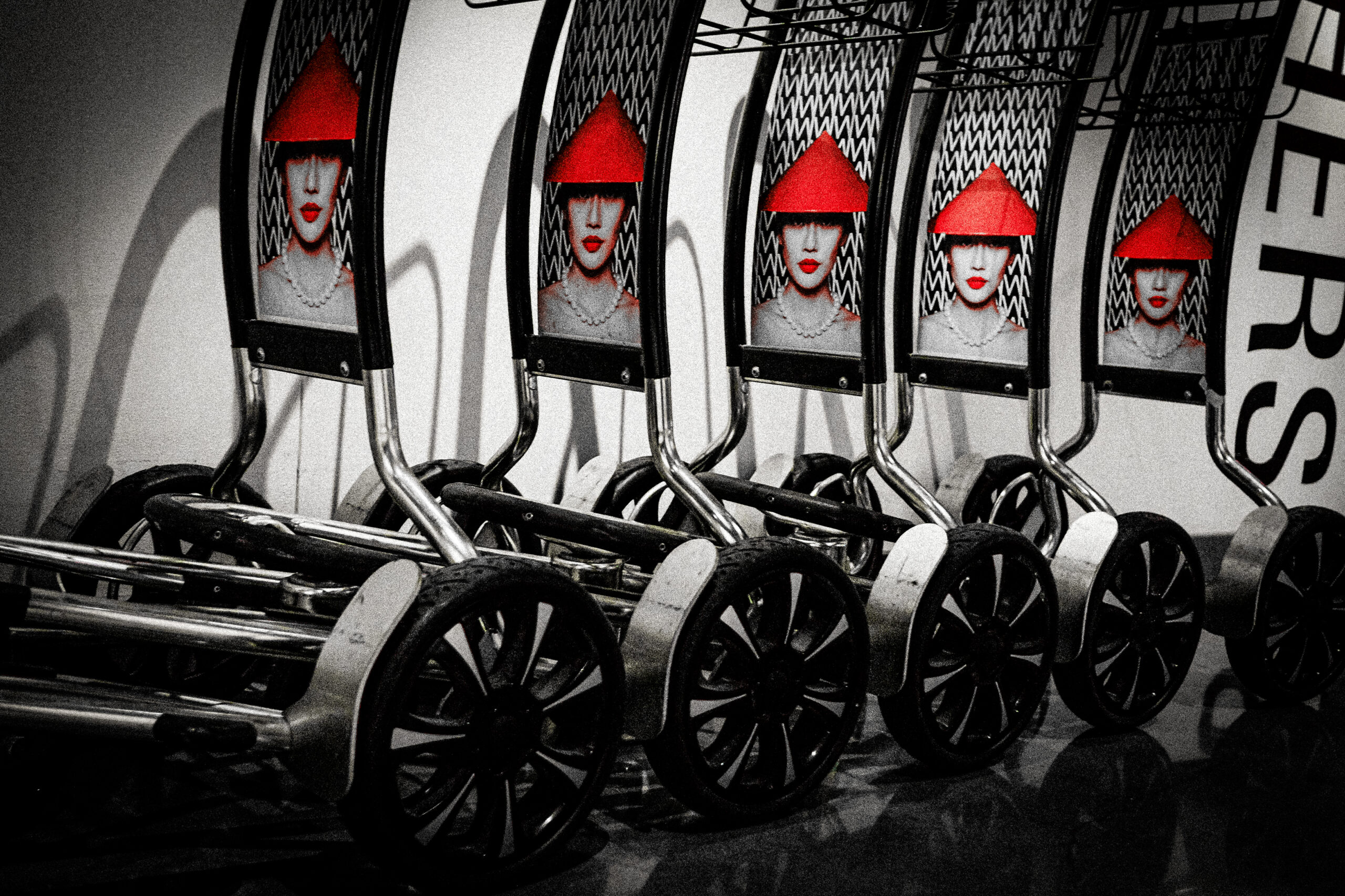
I work on wheels, as did my father and grandfather before me. Before him, too, it is possible there were wheel workers in our family, but I cannot say this with any real certainty; the human mind is a paper bag that can only contain so many groceries. The history of how I got here must share space with more practical matters like, did I pay the electricity bill? and, of course, how to fix wheels.
Sometimes people ask me if I fix bicycle wheels – like my grandfather – or car wheels – like my father – but no, I don’t – I only fix scooter wheels. They say there are 75 million scooters in Vietnam but I would go one step further and proclaim: there are at least 150 million scooter wheels in Vietnam, of which I own 2,000. My business is small in the scheme of Da Nang, at 20 cubic meters of storefront and another 400 cubic meters of wheel storage spread across the city. My store is called “Bánh Xe Thời Gian” (BXTG) – which, in English translates to “The Wheel of Time.” I always wish it was plural, but again, this name and the storefront were transferred unto me from those that came before me.
If I had to guess, I have fixed over 2500 wheels a month for the last 20 years. My wife would know best, she keeps all the records, handles the payments and maintains our finances, as did my mother and grandmother before her. Our system works and we don’t see it as work as much as we consider it revolution. The Earth revolves around the sun, while revolving itself, while we fix wheels. And somehow, yet, in purely angular terms, the wheels we fix revolve faster than axial rotation and orbital motion; little earths keeping our city alive. This is my favorite part of the wheel – the fact it spins faster than the earth, but at a lower linear speed. My second favorite part of wheels is the friction.
Anyways, last week I was fixing a wheel – #1723 of the month of June – when a young man came with an audacious claim. He said his great-grandfather got his bicycle wheels fixed here, his grandfather got his car wheels fixed here, and his father had gotten his scooter wheels fixed here. I welcomed him in, offered him some tea and thanked him for the wonderful story, as well as his family’s continued patronage over the years. He asked me if I had kids. I changed the subject back to wheels. He said if I did have kids, they would be his same generation and asked what type of wheel would they fix? This time I answered.
“Yes, I have two daughters. One lives in Japan and the other in Taiwan. Neither is married but they have plenty of time to make that decision for themselves. They don’t fix wheels – one works in healthcare and the other is a speech pathologist. They both take the subway to work. The subways have wheels but none of us have ever seen them. Even if we did see those wheels, there are no stores that fix subway wheels – those wheels are steel and not rubber. They turn slower than any wheels my family has ever fixed and they are not ‘fixed; but rather ‘reprofiled.’ It is a totally different art, one that belongs to a different family, perhaps.”
As if not understanding, the young man asked again – “if they did fix wheels what type of wheels would they fix?”
At first, I did not appreciate his stubbornness with this question – I am happy to speak about wheels from dusk to dawn, but not speculative wheels, hypothetical wheels, the future of wheels. Only the wheels of today. But as I thought of how to best answer his question, the words slipped out:
“Yes, my daughters fix wheels everyday. They fix the wheels trying to live a life free of pain and suffering. They fix the wheels trying to communicate their wants and needs, hopes and dreams. Yes, the wheel of tomorrow is the person sitting next to you – those are the wheels that spin the fastest – I am old news, but you, my friend, like my daughters, are the wheel of tomorrow.”